Diversity

A Rhyme That Carried My Heritage Across Generations
“भाषा केवल शब्दों का संग्रह नहीं होती, यह हमारी संस्कृति, हमारी यादों और हमारी पहचान को आगे बढ़ाने का माध्यम होती है।” (Language is not

South Asian Heritage Month 2026 celebrates the theme “Unity in Diversity”. This theme invites us to explore what unites us across our differences: shared values, intertwined histories, and a common commitment to community and belonging, while celebrating the beauty and strength that diversity brings.
The theme encourages us to appreciate the richness of South Asia, a region home to eight countries, hundreds of languages, multiple faiths, and millennia of both shared and distinct histories.
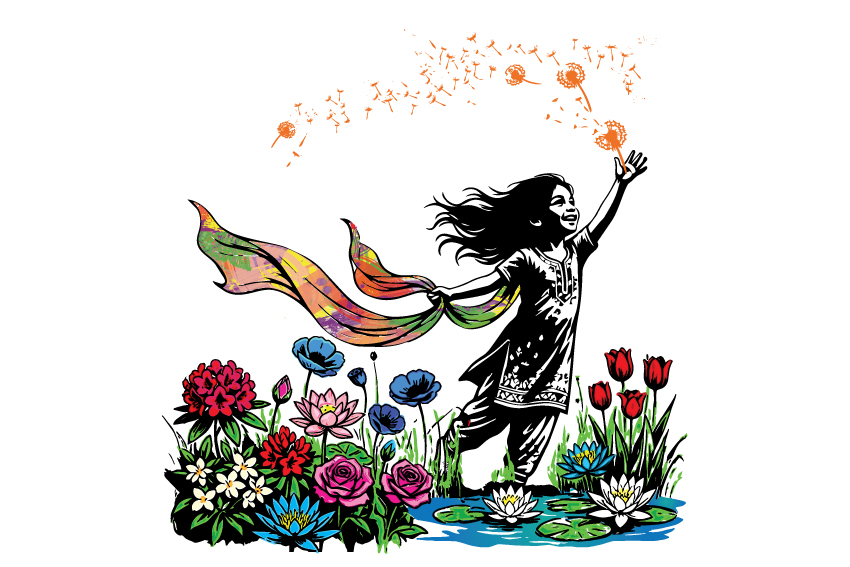
This year’s South Asian Heritage Month artwork beautifully captures this message through the national flowers of the eight South Asian nations. The illustration depicts a joyful young girl dressed in a shalwar kameez, a traditional South Asian outfit, clutching her dupatta (scarf) as she reaches for dandelions. At her feet lies a garden of the eight national flowers, creating a powerful image of a shared garden of South Asian heritage. Together, these flowers represent both individuality and unity, a perfect symbol for a region whose diversity is one of its greatest strengths.
But why are national flowers so symbolic? Much like flags, national flowers serve as powerful botanical emblems of a country’s identity, values, and history. They often carry deep cultural, mythological, and religious significance, appearing in folklore, literature, and art. On a diplomatic level, national flowers can become symbols of national pride and identity, helping to represent a nation on the world stage. Many of the flowers also celebrate native biodiversity and the unique natural heritage of their countries.
Although these flowers collectively embody the spirit of this year’s theme, each flower carries its own rich history, offering a unique insight into the values, heritage, and natural beauty of the country it represents. To understand the significance of these symbols, we must explore the stories behind them and how each flower came to represent its country.
 The tulip, known as Lala in Dari and Pashto, is one of Afghanistan’s most cherished national symbols. The tulip earned its place through centuries of deep cultural significance and popular recognition.
Growing naturally across Afghanistan’s mountains, valleys, and hillsides, it has long been woven into the country’s poetry, folklore, and collective memory. Influenced by Persian poetry, Afghan poets often use the red tulip to symbolise love, beauty, sacrifice, and remembrance. In many poems and folk songs, tulips are said to grow where lives have been lost, linking the flower to honour and memory.
Afghanistan lies within one of the world’s original habitats of wild tulips. Every spring, as the snow begins to melt, vibrant red blooms emerge across the landscape, transforming rocky hillsides and open fields with an abundance of colour. Their arrival signals the end of winter and the beginning of renewal.
The colourful flower also occupies a special place in Afghan literature and oral traditions. Growing naturally in harsh and unforgiving conditions, wild tulips thrive without irrigation or cultivation, surviving cold winters, dry springs, and rocky soils. Their ability to flourish despite adversity has made them a powerful symbol of resilience and hope. In poetry, folk songs, and traditional stories, the tulip often represents the strength of the Afghan people, reflecting both the challenges they have endured and their determination to persevere.
 The white water lily, known as Shada Shapla in Bangla, is the national flower of Bangladesh. Water lilies are among the oldest flowering plants on earth and were often found in ancient civilizations like Egypt, India, and Southeast Asia.
Found throughout the country’s rivers, ponds and wetlands, the white water lily is closely tied to Bangladesh’s identity as a land shaped by water. Bangladesh also has blue, pink, yellow, and red water lilies, however the white lily flower holds the most significance. The flower symbolises purity, resilience, and the natural beauty of the nation’s landscape. Its importance in Bengali culture and everyday life made it a natural choice as the country’s national flower. Its prevalence in water symbolises the nations ability to cope with floods and monsoons.
Beyond its symbolic value, the plant has also served practical purposes, with villagers traditionally using the stems, known as Shaplar Chora, as a source of food during times of hardship. Even now it is used in popular dishes such as Shapla Chingri, where the stems are stir-fried with prawns or Shapla Pakora, where the stems are dipped in a spiced batter and fried. Sometimes water lilies are used in traditional medicine and Ayurvedic traditions by locals.
Following Bangladesh’s independence in 1971, the flower became an even more prominent national symbol. A stylised white water lily appears on several government emblems and public institutions, and it was featured on the country’s first one-taka banknote issued in 1973. The flower’s enduring presence in national imagery reflects its status as a symbol of purity, resilience, and the close relationship between the Bangladeshi people and the waters that shape their homeland.
The Shapla‘s importance extends beyond the natural landscape and into Bangladeshi culture. Water lilies frequently appear in art, folk songs, and the works of Baul poets, symbolising the country’s deep connection to its rivers and wetlands.
One of the most famous patriotic and educational rhyme songs in Bangladesh, titled “Priyo Ful Shapla Ful”, introduces children to Bangladesh’s national symbols and natural beauty so they can learn about their national identity. Sang in Bangla, it frequently repeated the line “favourite flower is Shapla flower”, as well as referencing other national symbols such as the Doyel bird, the Royal Bengal Tiger, the jackfruit, and the Padma River. Through music, literature, and education, the water lily has become an enduring expression of Bangladeshi identity.
 The blue poppy, which grows in the high-altitude Himalayan regions of the country, is the national flower of Bhutan. Known scientifically as Meconopsis grandis, it was discovered in 1933 by British botanist, George Sherriff in a remote part of Sakteng in eastern Bhutan. At the time it was a captivating discovery as it was unlike any other poppy known.
With its distinctive blue petals and contrasting golden stamens the blue poppy’s beauty is one of the reasons it has become such a beloved national symbol. Growing at altitudes between 3,500 and 4,500 metres above sea level, often above the tree line, the flower flourishes in rocky mountain terrain where few other plants can survive. Reaching heights of up to one metre, its delicate petals range from pale sky blue to deep violet.
The combination of its vivid colour and fragile appearance creates an almost ethereal quality, making the flower a rare and captivating sight in the eastern Himalayas. In particular, the fact that the extraordinary flower thrives in harsh, high-altitude environments is seen as a metaphor for spiritual enlightenment, which often comes after overcoming significant obstacles. This simultaneously represents Bhutanese national identity, as its ability to thrive in these conditions resonates with Bhutan’s national philosophy of Gross National Happiness, a holistic philosophy which highlights the balance between material and spiritual wellbeing.
In Bhutanese culture, the blue poppy represents purity, peace, and spiritual aspiration. It’s rare and elusive nature has long been associated with the country’s deep-rooted Buddhist traditions, where the path to enlightenment is seen as a journey requiring dedication and perseverance. Bhutanese folklore also links the flower to stories of the mysterious Yeti said to inhabit the high Himalayan regions where it grows.
Like other national flowers, the blue poppy holds a significant place in Bhutan’s traditional medicine. It is believed that parts of the flower could be used to treat inflammation and digestive disorders.
Over time, the blue poppy has become a symbol of the harmony between the Bhutanese people and their natural environment. Its image frequently appears in paintings, embroidery, handicrafts, and literature, while conservation efforts help protect the flower in its natural habitat for future generations. As a result, the blue poppy continues to embody Bhutan’s unique blend of natural beauty, cultural heritage, and spiritual depth.
 The lotus, known as Kamal or Padma in Hindi, was officially declared India’s national flower on 26th January 1950. This aquatic plant of the Nelumbonaceae family rises unstained from muddy waters and can survive in both fresh shallow waters and muddy swamps. Despite growing in muddy waters, it blooms beautifully, symbolising the ability to rise above adversity, survival and purity of heart, mind and soul in all conditions. It has long symbolised purity, resilience, and spiritual awakening. Lotus flowers bloom most abundantly during the monsoon seasons of June to September and can be seen in places like Dal Lake in Kashmir or ponds in Kerala.
The lotus was not chosen merely for its beauty, this pink flower has held a sacred place in Indian culture for thousands of years and appears extensively in ancient art, architecture, literature, and religious traditions. Its significance is so deeply woven into Indian culture that scholar Thomas Kintaert in his 2010 book titled On the Cultural Significance of the Indian Lotus Leaf stated that:
“There is hardly any symbolism in Indian poetry, sculpture, and painting more vast than that relating to the lotus flower”.
The flower holds a sacred place within India’s major religions. In Hinduism, deities such as Lakshmi, the goddess of wealth, Saraswati, the goddess of wisdom, and Brahma, the creator, are frequently depicted seated upon or emerging from a lotus flower. The lotus is therefore associated with divinity, prosperity, knowledge, and enlightenment. Through its connection to Lakshmi and Brahma, the lotus also became a symbol of fertility and creation. Similarly, in Buddhism, the flower symbolises the journey towards enlightenment, with tradition stating that lotus blossoms appeared wherever the Buddha took his first steps. In Sikhism, the lotus is also a powerful spiritual symbol, frequently referenced in the Guru Granth Sahib as a metaphor for remaining spiritually pure while living in the material world. Just as the lotus grows from muddy waters yet blossoms untouched on the surface, Sikhs are encouraged to lead active worldly lives while remaining free from attachment, corruption, and negative influences through devotion to the Divine.
Beyond religion, the lotus has been a prominent motif in Indian art, architecture, literature, and philosophy for thousands of years. In the Hindu scripture, Bhagavad Gita, the flower serves as one of its most powerful spiritual metaphors. It is used as a metaphor for detachment, teaching that individuals should live in the world while remaining unaffected by material attachments, just as the lotus remains untouched by the muddy waters from which it grows.
In yoga, the lotus posture, known as Padmasana in Hindi, is honoured for its ability to calm the mind and promote mindfulness. For generations the lotus has stood as an enduring emblem of hope, spirituality, and the unity of a diverse nation.
 The pink rose, locally known as Finifenmaa, is the national flower of The Maldives. Officially declared the nation’s floral emblem in July 1985, this delicate flower is admired throughout the islands for its beauty, gentle pink petals, and distinctive fragrance.
Unlike many national flowers that grow wild in their native landscapes, the pink rose was chosen because it has long been cultivated in Maldivian homes and gardens, where it is cherished as a symbol of elegance, purity, and natural beauty. The pink rose thrives in The Maldives, despite being made up of low-lying coral islands and sandy atolls that can make cultivation challenging. Commonly grown in public gardens and household courtyards, the flower’s widespread presence helped establish it as a natural symbol of the nation and its people.
Known scientifically as Rosa Polyantha, it holds a special place in Maldivian culture and traditions. In particular, its strong, sweet fragrance has been valued in religious and celebratory occasions, including weddings and community gatherings. Rose water and rose petals have also been used in traditional practices. As a predominantly Muslim nation, the rose has often been associated with spirituality, purity, and devotion. Rose water and the petals are often used to make tea or desserts by locals.
The pink rose appears in festivals, educational materials, artwork, and public displays, serving as a reminder of The Maldives’ unique natural heritage and cultural identity. Schoolchildren often create drawings of the national flower, and it is frequently seen in tourist souvenirs.
The pink is held so highly that local gardeners often promote Finifenmaa propagation workshops, to encourage locals to cultivate the flower correctly. Admired for its elegance, fragrance and beauty, the rose has become a cherished symbol throughout the islands. Its popularity and widespread cultivation contributed to its recognition as the country’s national flower.
 The rhododendron, known as Lali Gurans in Nepali, is the national flower of Nepal. The flower is Rhododendron arboreum, a species celebrated for its vibrant crimson-red blossoms that cover Nepal’s hillsides and forests each spring. While the flowers are most commonly associated with their striking red colour, they can also appear in shades of pink and white, particularly at higher altitudes in the Himalayas.
Blooming between March and May, the Lali Gurans transforms Nepal’s mountain landscapes into a sea of colour, attracting nature lovers, trekkers, and photographers from around the world. Found across the Himalayan region at elevations of around 2,400 to 2,800 metres, the flower has become synonymous with the arrival of spring. For many Nepalis, the first blooms are a welcome sign that winter has ended and warmer days are ahead.
This red flower can be found in Bhutan, China, India, Myanmar, Nepal, Sri Lanka, Pakistan, and Thailand. The rhododendron was chosen specifically as Nepal’s national flower because it perfectly reflects the country’s extraordinary natural beauty and biodiversity. Nepal is home to more than thirty species of rhododendron, yet the bright red Lali Gurans remains the most celebrated.
Beyond its beauty, the flower plays an important role in everyday life. Rhododendron blossoms are offered at temples, used to decorate homes during celebrations, and are often worn in the hair by women and young girls. In the Himalayan regions, the petals are used to make teas, drinks, pickles, and traditional remedies, reflecting the flower’s close connection to local communities. Popular Nepali songs frequently reference the Lali Gurans as a symbol of beauty, love, and national pride. It remains one of Nepal’s most cherished symbols.
 The jasmine flower, known as Chambeli or Motia in Urdu, is the national flower of Pakistan. Officially declared the nation’s floral emblem on 15th July 1991, this fragrant flower is renowned for its delicate white petals and sweet aroma. Originating in the foothills of the Himalayas, the plant was cultivated and brought to India, China, and the Middle East. Widely grown throughout Pakistan, particularly in the warmer regions of Punjab and Sindh, jasmine flourishes in gardens, courtyards, and public spaces, filling the air with its distinctive scent.
The flower was chosen as Pakistan’s national symbol because of its beauty, abundance, and deep cultural significance. Long associated with purity, simplicity, and attachment, jasmine embodies values that resonate strongly within Pakistani society. Its small white blossoms are seen as a reflection of modesty and grace, while its ability to thrive in a variety of environments symbolises Pakistan’s resilience and endurance.
Jasmine is deeply woven into Pakistan’s cultural and social traditions. The flowers are commonly used in garlands, known as gajras in Urdu, and feature prominently in weddings, religious gatherings, festivals, and other celebrations. Brides and grooms are often adorned with jasmine garlands, where the flower symbolises love, unity, and happiness.
Jasmine also contributes to Pakistan’s economy. The flower is cultivated for its essential oil, which is used in perfumes, cosmetics, and traditional remedies. Its therapeutic fragrance has long been associated with relaxation, further enhancing its popularity across the country. Jasmine remains an enduring part of Pakistani life.
 The blue water lily, locally known as the Nil Manel in Sinhala and Neelothpalam in Tamil, is the national flower of Sri Lanka. Scientifically known as Nymphaea stellata, this beautiful flower has delicate pale blue to violet star-shaped petals surrounding a bright yellow centre. Found throughout the island’s ponds, lagoons, and shallow waterways, the flower has been cultivated since ancient times and is closely associated with Sri Lanka’s natural beauty and cultural heritage.
Officially declared Sri Lanka’s national flower on 26th February 1986, it was chosen for its widespread presence across the country and its deep historical and spiritual significance. Growing naturally in shallow waters throughout the island, the flower has long been admired as a symbol of truth, purity, serenity, and discipline. Its ability to emerge pristine from muddy waters has also made it a powerful symbol of inner strength and moral virtue.
Like many of the other national flowers that hold religious significance, the blue water lily holds an important place within Sri Lanka’s Buddhist traditions. It is believed to be one of the 108 auspicious symbols associated with Prince Siddhartha and has been used as a ceremonial offering in Buddhist worship for centuries. Flowers are frequently placed at temples and shrines as acts of devotion, while the water lily’s graceful form has become closely linked with spiritual enlightenment and peace.
It has become a symbol of Sri Lanka’s rich biodiversity and natural heritage. During flowering season, the country’s waterways are transformed by the blooms, creating scenes that have inspired artists, poets, and writers for generations. Today, the flower remains one of Sri Lanka’s most cherished national symbols, representing the harmony between nature, culture, and spirituality that lies at the heart of Sri Lankan identity.
Together, these eight national flowers tell a story that goes far beyond botany. The national flowers of South Asia tell stories of geography, culture, faith, and identity. Each flower reflects the unique character of its nation, yet together they create a powerful symbol of South Asia. They reveal common themes that run throughout South Asia: resilience, spirituality, beauty, renewal, and a deep connection between people and nature
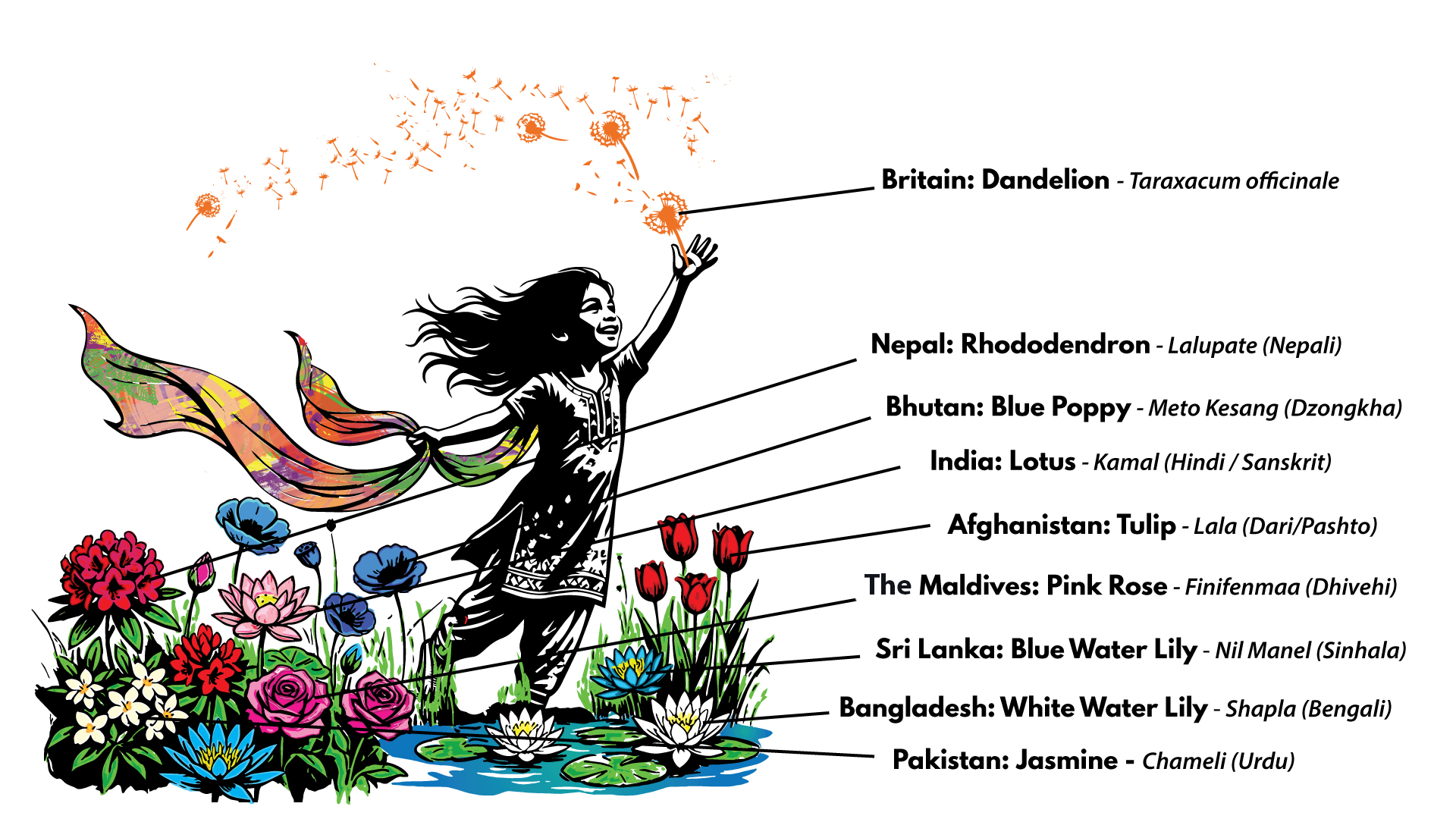
As South Asian Heritage Month 2026 celebrates “Unity in Diversity”, these flowers serve as a powerful reminder that while each nation has its own distinct identity, they are united by shared cultural values, intertwined histories, and a rich heritage that continues to flourish across the region.
“भाषा केवल शब्दों का संग्रह नहीं होती, यह हमारी संस्कृति, हमारी यादों और हमारी पहचान को आगे बढ़ाने का माध्यम होती है।” (Language is not


My Vitiligo Journey: From Silence to Empowerment This year marked my 17th World Vitiligo Day, which took place on 25th June 2026. It was a


First-generation immigrants arriving in the country faced some challenging times. They often came with very little in terms of personal possessions, encountered language barriers and

Although the migration of South Asians to the UK goes back many centuries, numbers grew significantly during the 50s, 60s and 70s. Many travelled here


Artists impression of Scotland’s First BIA Memorial Colourful Heritage, a charity based in Scotland were granted planning permission by Glasgow City Council in December 2022

When I heard this year’s South Asian Heritage Month theme is Unity in Diversity, my first thought was of the power of trust, relationships, and