“There were some scary moments. Really fast moving, unknown civilian vehicles used to come in the VCP (Vehicle Check Point) location and the platoon commander, who I was attached with, ordered to fire on that car, so we fired at him but we had been trained to shoot at the tyres first, causing minimum lethal damage. That was how we did it. I was on top of a hill and that was my first moment seeing that kind of action carried out from our team, and that was quite scary. Later it turned out he was a suspicious guy and we (apprehended) him later. That was my first encounter.”
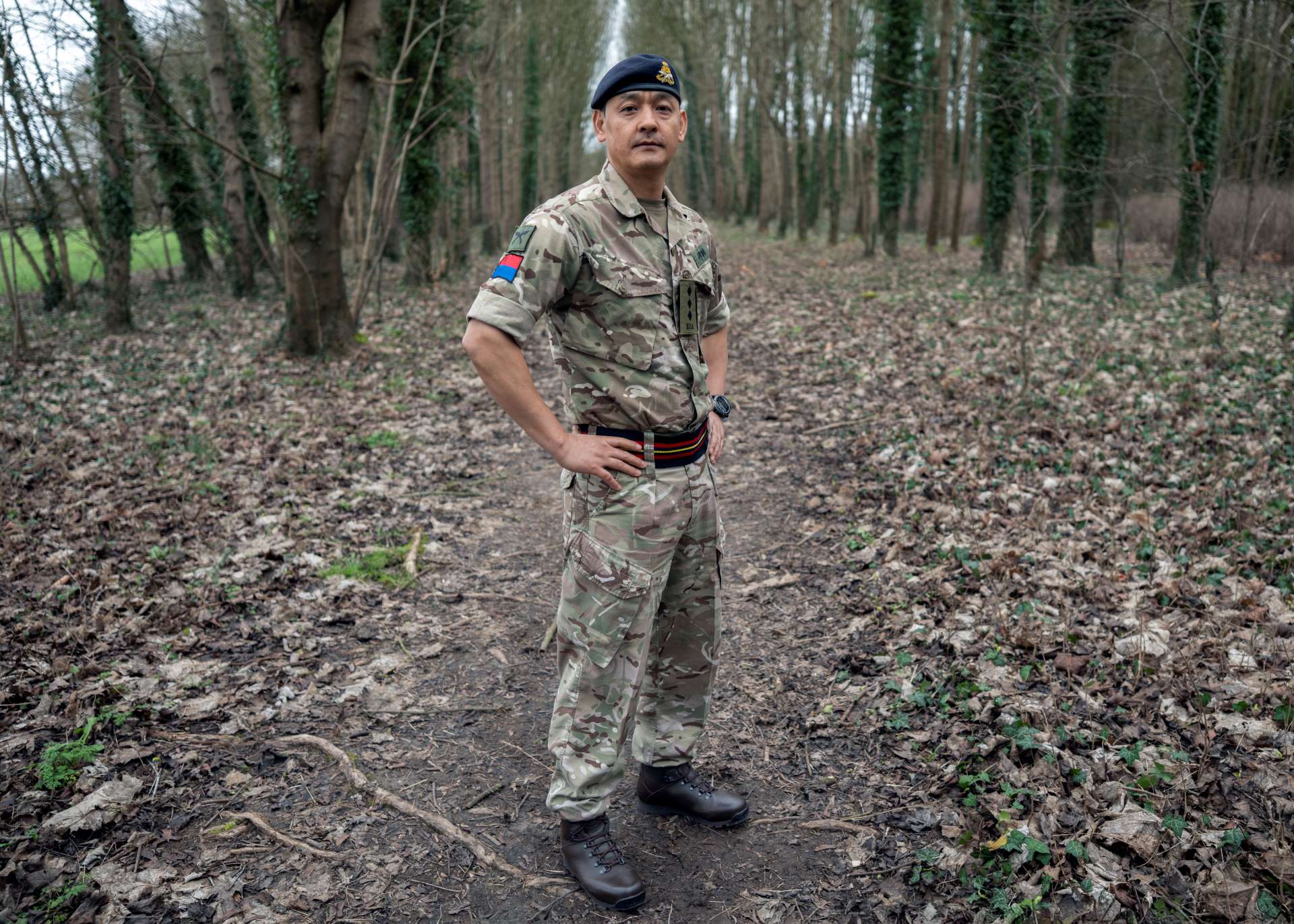
Arunhang Nembang recalls this story when, as a young Rifleman, he was deployed to Iraq. The Gurkhas in the British Army have a reputation of being amongst the finest soldiers in the world. There are over 4,000 Gurkhas employed across many trades and all are recruited from Nepal, with many thousands of young people attempting selection every year. One of these was Arunhang in 1999.
He grew up in eastern Nepal near Phidim. “My uncle was in the British Army, he served in Hong Kong.” But his main inspiration was his elder brother who tried for selection, but sadly was unsuccessful. Arunhang recalls: “He said to me ‘you have to try, I couldn’t make it, so if you try then you can realise my dream as well.’ He inspired me, my brother, so I started to work hard to train myself physically, and fortunately I passed first-go.”
There were several strenuous phases of selection. His brother was by his side: “he would run with me 5 or 10km uphill, downhill, both free run and with weights in Doko (basket), preparing for 2 km run and 5km Doko race with 25kg weight.”
“It is every family’s dream in Nepal for your family member to join the British Army, like a dream come true. I was over the moon.” In late 1999 Arunhang and his new comrades travelled to Brunei, to the British Army training base to begin this new journey in their lives.
Training and Deployment
After a few months they reinforced the Royal Irish Regiment in the UK, and later Arunhang was deployed on an operational tour in Sierra Leone, where he was a radio operator. Further training, however, saw him progress in a specialised role. “I did well, I was sniper badged. You have so many skills and you have to hit all of them to a high level, if you fail one you will not get badged. So, I (was) top in the course and won an award as well. Later when we were told we were going to Iraq, I was chosen to deploy as a sniper.”
Arunhang recalls 11th September, 2001: “I was on exercise in the UK at that time, doing TAL (Tactical Air Landing) exercises… We saw live on the TV the aircraft hit the twin towers on the BBC. “
“We were part of 16 Air Assault Brigade, which is always on high readiness, we understood that there might be something coming in the near future and we started anticipating that we might be going somewhere; to war. That instantly came out of people’s minds.”
There was significant training before deployment. “I still remember going out training on all sorts of things… we flew to Kuwait at the end of January 2003 and stayed there for a month or more in the desert, training and preparing for actual war in Iraq.”
Billeted in tents, they had severe sandstorms to contend with. “You can’t imagine: the strong winds when the storms come in the night! When we went to the toilet, you came back and lost your tent!”
Communications with home were very limited. “My mum and dad were really, really worried because of the nature of the operation, there were lots of scary moments. (My dad) cried a few times before we left. There were no TVs in our village so he used to travel down to Phidim town where there was a small black and white television: he used to tell me stories later that he watched every piece of news.”
Entering Iraq
Arunhang recalls entering Iraq with CBRN (Chemical, Biological, Radiological and Nuclear) kit and respirator: “We trained with it, fought with it, did ranges, long marches, putting on CBRN kit. Even in Kuwait before we crossed the border, we did lots of marching in that heat… We were prepared but it was a scary and nervous time.”
“It was really, really tough, especially moving along from the southern border between Kuwait and Iraq, for about a month; every stop you had to dig a trench in that heat and with your body armour on, you had to dig the trench and constantly you got ‘Gas Gas Gas’, CBRN sirens. You had to put your respirator on, that was one of the most difficult times I experienced.”
A clear memory for Arunhang is “driving in the four-tonne, soft-skinned vehicles with the sandbags on the side and bottom to protect from small-arms-fire, ballistic explosions… the four-tonne was already really heavy because of the sandbags and we struggled so much in that vehicle because with the troops, about 20 of us… many times [laughs], we had to get out and push.”
Initially charged with securing southern oilfields and infrastructure, they saw the impact of the invasion force. “The mortar rounds and missile effect on a hard tarmac road, and especially lots of dead bodies in front of trenches, the oil fields were burned, and that was really exactly like what I imagined a battlefield to be. Looking at that was a really scary moment for me. But later as we moved, we became used to it.”
On Operations
Snipers operate in pairs and “are always isolated from the team, and normally you don’t work closely with your platoon or company… Many times, we stayed on top of buildings while our teams were conducting security patrols and constantly you have to watch their movement.”
The role is physically and mentally tough “because you have to have constant observation overwatch on key objectives and give constant feedback to report the situation. It is quite challenging and especially where you feel protected is fine, but when you are isolated, asked to get 2 or 3km away on the high ground, that is the moment you get scared, when you are isolated. I remember a few times when we were sniping, lots of camels used to travel along and they ended up coming close to us many times [laughs] in the dark and they scared us so much!”
“A few times I came across anti-personnel mines too, that scared me a lot. We didn’t have good experience on mines at that time, but later I knew more about them. I came across that many times with my sniper team on the flanks or high ground.”
Interactions with the Iraqi people were not friendly at first. “We moved further up to Basra, Al Amarah District, where we established our FOB (Forward Operating Base), where we conducted our patrols. At that time we got to interact closely with the Iraqi civilians and most of them were not that friendly, but some talked with us. It was easy to talk with them because most of them speak Hindi, that was an advantage for Gurkhas, we could communicate with them. They were surprised at that; they were wondering where these guys came from who could speak Hindi! [laughs].”
“We interacted with the civilians a lot and the more you engaged, the more they would come to you.”
They would also take their rations of biscuits with them when driving. “We kept them in our four-tonne and gave to the local Iraqi kids when we were travelling around. When we patrolled in Al Amarah District, we would get food in the town, we managed to get some and cook in the mess tin, that is part of Gurkha culture.”
“No goat, but chicken: we were lucky to get that in the town centre, we managed to buy some and cooked in the mess tin, that was one great memory for me, making some Gurkha curry and cooking chicken in one small building where I was sniping from the top, I still remember that moment! [laughs]”